
Dance
La fille mal gardée
, September 2024
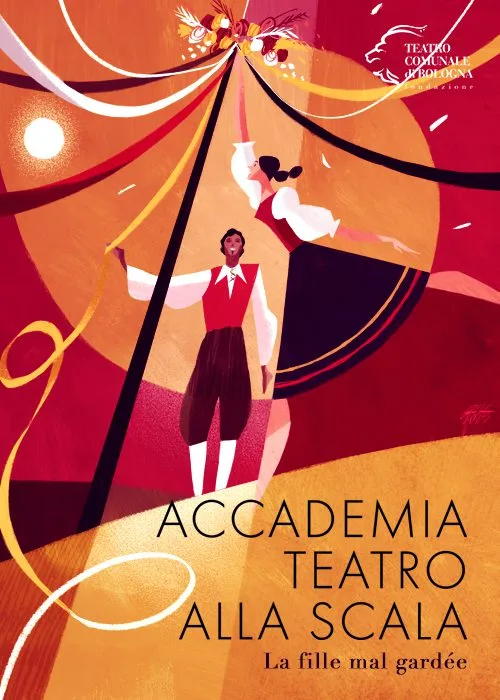
The show
- Music
- Peter Ludwig Hertel
Company
-
Company Scuola di Ballo dell'Accademia Teatro alla Scala
Choreography
-
Choreography Frédéric Olivieri
Programme
-
La fille mal gardée
- Music
- Peter Ludwig Hertel
-
CANTICLE FOR INNOCENT CREATURES
- Music
- Jason Moran
-
DIVERSION OF ANGEL
- Music
- Norman Dello Joio
-
EKSTASIS
- Music
- Ramon Humet
-
ERRAND INTO THE MAZE
- Music
- Gian Carlo Menotti
Creative team
- Sets
- Luisa Spinatelli
- Lighting designer
- Andrea Giretti
- Costumes
- Luisa Spinatelli
- Sets and costumes reworked by
- Angelo Sala
- Sets and costumes reworked by
- Maria Chiara Donato
Dates and tickets
Dates and performances
-
Slot EAt 20:30
-
Slot FAt 16:30
Running time
Total 110 min. approx.
Venue
Comunale Nouveau
Details
- Information
-
La fille mal gardée is among the oldest ballets still in the repertoire, having been born at the time of the French Revolution. Jean Bercher Dauberval created the first choreography, under the title Le ballet de la paille, ou il n’est qu’un pas du mal au bien, staged at the Grand Théâtre de Bordeaux in 1789 to a medley of French folk themes and songs. Over time the ballet has seen many editions and many changes of title, of characters’ names, of choreography and of score. The director of La Scala’s ballet school has chosen Hertel’s score, composed in 1864 for Paolo Taglioni’s version for the Berlin Hofoper and performed at La Scala in 1880.
The ballet, which includes several mime numbers as the tradition of the eighteenth-century genre comique requires — with a contemporary setting steeped in a rural landscape and peasant life — tests the pupils of La Scala’s ballet school not only technically, since the choreography is designed to show off their classical academic skills, but also as performers, because it calls for considerable gifts of irony and gesture, especially for some of the characters, such as Mme Simone, played here by a female pupil rather than by the traditional dancer en travesti. Some sixty very young dancers from the 2nd to the 8th year take the stage.
A country setting. A mother, a daughter. Hard-shelled on the surface, the first. Delightful and capricious, the second. In love with love, the girl, whose name is Lise, has eyes only for Colas, a farmhand. Her mother, the widow Simone, would like a marriage of convenience for her Lise with the son of the landowner Thomas: but the boy is a fool, his name is Alain, and his head is full of nothing but catching butterflies.
La fille mal gardée (the badly guarded girl), which enters the repertoire of the Ballet School of the Accademia Teatro alla Scala in the new version by its director Frédéric Olivieri, is a story to be danced with comic and theatrical flair: a plunge into the tradition of the best ballet d’action, a genre born in the eighteenth century whose spokesman was Jean-Georges Noverre, with Franz Hilverding and Gasparo Angiolini. Noverre trained at the Paris Opéra and in his extraordinary career travelled the whole of Europe; Jean Dauberval, the choreographer of the first version of La fille mal gardée, originally called Le ballet de la paille, ou il n’est qu’un pas du mal au bien, was his pupil.
Why mention Noverre? Because Dauberval’s ballet, which opened in Bordeaux on 1 July 1789, in the year of the French Revolution and fourteen days before the storming of the Bastille, is a key title in that unity of dance and mime called for by Noverre in 1760 in his Lettres sur la danse et sur les ballets. A unity through which dance — which had not yet known the use of pointe shoes — might recover the truth of a voice by then buried under costumes and exaggerated virtuosity: the voice of nature. And even if La fille mal gardée has, in the end, little to do with the political battles of 1789, with its peasants, its popular setting and its story of love and skirmishes it nevertheless embodies the beginning of a revolution: that of the «ballet genre», of which Noverre’s writings are still the emblem. A ballet with the ability to tell a story leaning on nothing but itself.
No more crinolines, wigs, masks or paniers with their hooped underskirts for the dancers, the daughters of Terpsichore: Noverre has new commandments. Abandon costumes that hide the body and its expression; take affectation out of dance; dare to give up steps that are too complicated; put less force into the execution and more spirit; give dance a soul. «’Action’», Noverre writes, «is simply mime. Everything must be described, everything must speak through the dancer (…) Gesture draws its principle from the passion it must render». Allergic to virtuosity unless it was joined to the heart, Noverre also writes: «Let no one think I am trying to abolish the ordinary movements of the arms, all the difficult and brilliant steps (…); let the arms, in agreement with the eyes, the face and the steps, make ‘the cry of nature’ be heard». How modern for its time!
Frédéric Olivieri’s decision to choreograph a new version of La fille mal gardée for his pupils, on pointe as has been the tradition of revivals since the nineteenth century, has given the young performers the chance of a creative journey rediscovering the expressiveness of mimed gesture joined to dance. Of the two scores most used in the various versions of La Fille, Olivieri chose Peter Ludwig Hertel’s.
«Among the sources I consulted», Olivieri says, «I was partly inspired by the version danced in North and South America, which goes back to the edition Bronislava Nijinska brought to American Ballet in 1940 and which was later revised in Cuba as well. It is a version that is rather too much of a caricature for me, but I like its energy, the musical découpage made on Hertel, the spirit and the use of mime».
«As in every edition of the ballet, mine has the clog dance, which I wanted to give to Lise’s mother alone, the butter scene, the ribbons… The choreography follows the coherence of the story but is entirely new, except for the last pas de deux, very well known from Gorsky’s twentieth-century version onwards: it is danced at competitions and galas, and for teaching purposes I wanted our young dancers to learn it in the traditional Russian version, thanks also to the teaching of our master Leonid Nikonov. My Fille is a ballet in two acts and four scenes: once the widow Simone has accepted the love between Lise and Colas in the second act, the action moves back from the house to the fields for the celebration where the famous pas de deux is danced, in a collective finale with all of Lise and Colas’s friends, where I have also introduced a dance for ten couples from the youngest classes».
More events
Discover every performanceDance
Notte Morricone
28, 29 November 2026
Teatro EuropAuditorium
- Music
- Ennio Morricone
- Company
- Centro Coreografico Nazionale / Aterballetto
Dance
Sergio Bernal Dance Company
13, 14 March 2027
Teatro Comunale
- Music
- Canto Gregoriano; José Jiménez "El Viejin"
- Company
- Sergio Bernal Dance Company